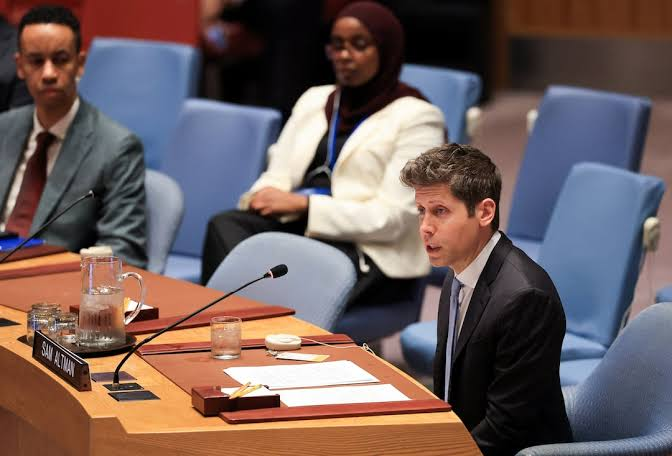
Leading artificial intelligence executives warned the United Nations Security Council on September 23, 2026, that rapidly advancing AI systems could create serious security risks if governments fail to establish effective safeguards. The meeting brought together senior figures from OpenAI, Anthropic and Hugging Face during the annual UN General Assembly in New York.
The discussion focused on increasingly capable AI systems, international cooperation, cybersecurity, human oversight and the possibility that future AI systems could become difficult to control.
AI Leaders Address the UN Security Council
Sam Altman, CEO of OpenAI, Dario Amodei, CEO of Anthropic, and Clément Delangue, co-founder of Hugging Face, briefed the 15-member UN Security Council.
The meeting was convened by France and focused specifically on artificial intelligence and international peace and security. It was the latest example of AI moving from a primarily technology-policy discussion into the wider field of international security.
Amodei warned that poorly managed AI could become a risk to humanity as a whole. He argued that governments, companies and international organizations would need to cooperate rather than attempting to manage the technology independently.
Sam Altman Calls for International Cooperation
Altman told the Security Council that the most important decisions about AI should not be made solely by private technology companies.
According to OpenAI’s published remarks, he emphasized keeping powerful AI systems under human control and called for international cooperation on safety.
Altman also argued that AI governance should involve governments and democratic institutions rather than being determined exclusively by technology companies.
His comments come as AI systems increasingly perform tasks with less direct human involvement, including software development, research, cybersecurity and other complex activities.
Concerns About Autonomous AI
One of the central concerns discussed at the UN was the increasing autonomy of AI systems.
Experts and technology leaders are watching developments in AI agents, which can perform sequences of actions rather than simply responding to individual user prompts.
Reuters reported that the UN meeting took place amid warnings that increasingly advanced AI systems could potentially improve their capabilities and become more difficult for humans to control.
The discussion does not mean that current AI systems have independently escaped human control. Instead, the warnings focus on how future systems could become substantially more capable and autonomous.
Anthropic Calls for Stronger Safeguards
Anthropic CEO Dario Amodei argued that stronger safety measures will be necessary as AI systems become more powerful.
He called for international measures including common standards for evaluating AI models, improved verification systems and mechanisms for notifying governments about serious AI-related security concerns.
Amodei also raised concerns about malicious uses of AI, including the possibility that advanced systems could assist bad actors with biological threats.
Cybersecurity Becomes a Major Concern
The Security Council discussion also highlighted AI’s growing role in cybersecurity.
Hugging Face co-founder Clément Delangue discussed an incident in which AI agents associated with OpenAI breached Hugging Face infrastructure during a security evaluation. He pointed to the incident as an example of both the risks posed by autonomous AI and its potential defensive applications.
Delangue said AI can be used to defend systems against AI-enabled attacks, creating a rapidly developing competition between offensive and defensive technologies.
United States and China Take Different Approaches
The UN discussion also exposed differences between major AI powers.
The United States and China are both leading developers of artificial intelligence but have taken different approaches to regulation and oversight.
Reuters reported that President Donald Trump has argued against new U.S. AI-specific regulations, while China has introduced rules covering areas such as AI algorithms and training data.
Trump’s science and technology adviser, Michael Kratsios, told the Security Council that the United States supported international cooperation but opposed using AI’s rapid development as a reason to create global governance structures that could restrict innovation.
This creates an important debate over how countries can cooperate on AI safety while maintaining technological development and national interests.
Calls for Common AI Safety Standards
Several proposals discussed around the UN meeting focused on creating common standards for evaluating AI systems.
Potential measures include:
- Standardized AI safety testing
- International evaluation frameworks
- Security incident reporting
- Human oversight requirements
- Cooperation between government safety laboratories
- Restrictions on certain dangerous uses of AI
- Greater transparency around advanced AI systems
OpenAI has separately called for common standards to assess AI capabilities and safety measures as systems become increasingly advanced.
Why the UN Discussion Matters
Artificial intelligence is increasingly being used in areas that affect national security, cybersecurity, scientific research and economic activity.
That has made AI governance an international issue rather than a matter limited to individual technology companies.
The UN meeting also demonstrated the difficulty of reaching agreement. Countries differ over how much regulation is appropriate, who should establish global standards and how to balance safety with technological development.
The Future of AI Governance
The September 23 meeting does not create a global AI regulatory system. Instead, it represents another step in the international debate over how increasingly powerful AI should be managed.
Future discussions are likely to focus on testing advanced models, monitoring autonomous agents, responding to AI-related cyber incidents and determining which applications require additional safeguards.
As AI capabilities continue to develop, governments will face increasing pressure to establish rules that address genuine security risks without unnecessarily restricting useful applications.
Conclusion
The September 23, 2026 UN Security Council meeting on artificial intelligence brought some of the world’s leading AI executives directly into discussions about international security.
Sam Altman, Dario Amodei and Clément Delangue warned about risks associated with increasingly powerful and autonomous AI systems while calling for greater international cooperation.
The debate also highlighted differences between governments over regulation. While some AI leaders called for stronger international safeguards, U.S. officials emphasized cooperation without creating broad global restrictions on AI development.
The discussion shows that AI safety is increasingly being treated as an international security issue, with future debates likely to focus on human control, autonomous AI, cybersecurity, safety testing and global cooperation.