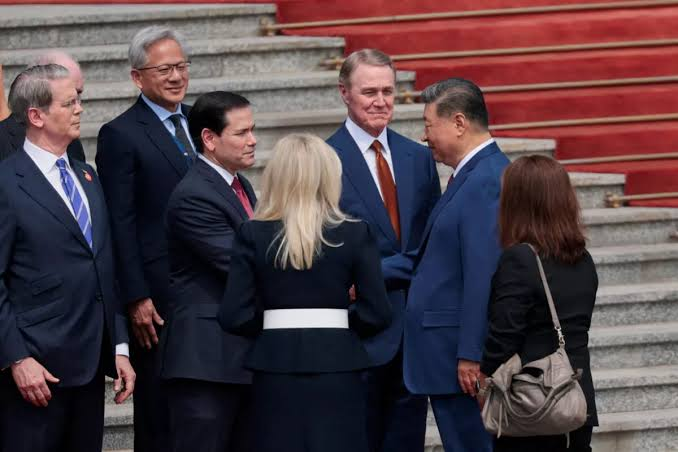
U.S. President Donald Trump and Chinese President Xi Jinping concluded their three-day Washington summit on September 25, 2026, ending a closely watched state visit that combined formal ceremonies, trade negotiations and discussions on major geopolitical issues. The leaders ended the visit with a tour of the U.S. National Archives and a private tea meeting.
The summit produced some concrete agreements, particularly on trade and communication between the two countries, while several major disagreements—including Taiwan, artificial intelligence and broader strategic competition—remained unresolved.
Trump and Xi Visit the National Archives
On the final day, Trump and Xi visited the U.S. National Archives in Washington, where they viewed historic American documents including the Declaration of Independence, Constitution and Bill of Rights. The visit followed a formal state dinner at the White House the previous evening.
The highly ceremonial schedule emphasized the personal relationship between the two leaders, while negotiations between their governments continued on economic and security issues.
U.S.-China Trade Truce Extended
One of the main outcomes was an extension of the existing U.S.-China trade truce by two months.
The extension gives negotiators additional time to work toward a broader economic agreement. The previous arrangement had reduced some of the tariffs imposed during the U.S.-China trade dispute and eased restrictions involving critical minerals and other products.
The two governments also discussed reducing tariffs on approximately $30 billion worth of non-sensitive goods and increasing market access.
China also indicated plans involving purchases of U.S. agricultural products, while Washington continued to seek greater access for American businesses in the Chinese market.
Artificial Intelligence Remains a Key Issue
AI was another important subject during the summit.
Trump and Xi agreed to establish an AI safety communication channel intended to allow the two countries to communicate about AI-related risks and crises. They also agreed to continue discussions between officials on artificial intelligence.
However, the summit did not produce a major agreement to slow the development of advanced AI systems. The United States and China remain competitors in AI research, computing infrastructure and advanced technology.
Taiwan Remains Unresolved
Taiwan continued to be one of the most sensitive issues between Washington and Beijing.
During the visit, Xi reiterated China’s opposition to Taiwanese independence and called on Washington to maintain what Beijing considers the appropriate position on the Taiwan issue.
The United States maintains its longstanding policy toward Taiwan while providing the island with defense equipment. No major new agreement resolving the Taiwan issue was announced during the summit.
Military Communication to Continue
Washington and Beijing also agreed to continue efforts to reduce the risk of military misunderstandings.
According to the Associated Press, the two countries agreed to enhance military crisis communications and work through mechanisms designed to prevent incidents from escalating.
Such communication channels are particularly important because U.S. and Chinese military forces operate in the same broader regions, especially around the Indo-Pacific.
Iran and Ukraine Discussed
The leaders also discussed major international conflicts, including Iran and Ukraine.
The Iran war has created significant economic and diplomatic complications for both countries, while China’s relationship with Russia remains an important issue for Washington.
These subjects added a broader geopolitical dimension to a summit that was otherwise heavily focused on trade and economic relations.
More Trump-Xi Meetings Planned
The Washington summit will not be the last planned meeting between Trump and Xi this year.
The leaders are expected to meet again at the Asia-Pacific Economic Cooperation summit in China in November and at the G20 summit in Miami in December.
The continued meetings provide additional opportunities for negotiations on trade, technology and security issues.
What the Summit Produced
The main announced developments included:
- Extension of the U.S.-China trade truce
- Further negotiations on a broader trade agreement
- Discussion of tariff reductions on non-sensitive goods
- An AI safety communication channel
- Continued military crisis communication
- Further trade and investment discussions
- Plans for additional Trump-Xi meetings
At the same time, major disagreements over Taiwan, AI competition and broader geopolitical issues remained.
Global Economic Impact
The U.S. and China are two of the world’s largest economies, meaning changes in their trade relationship can affect companies and consumers worldwide.
Tariffs influence the cost of imported products, while restrictions on semiconductors and rare-earth materials affect technology and manufacturing supply chains.
The extension of the trade truce therefore gives businesses additional time to prepare for future negotiations while avoiding an immediate return to higher trade barriers.
Conclusion
The Trump-Xi Washington summit ended on September 25, 2026, with both governments maintaining diplomatic engagement and extending their trade truce. The leaders also agreed to continue cooperation and communication on AI and military crisis management.
However, the summit did not resolve several major disputes. Taiwan, artificial intelligence competition and broader U.S.-China strategic tensions remain important issues for future negotiations.
The planned meetings in China and Miami later in 2026 will provide additional opportunities for the two governments to negotiate trade, technology and security matters.