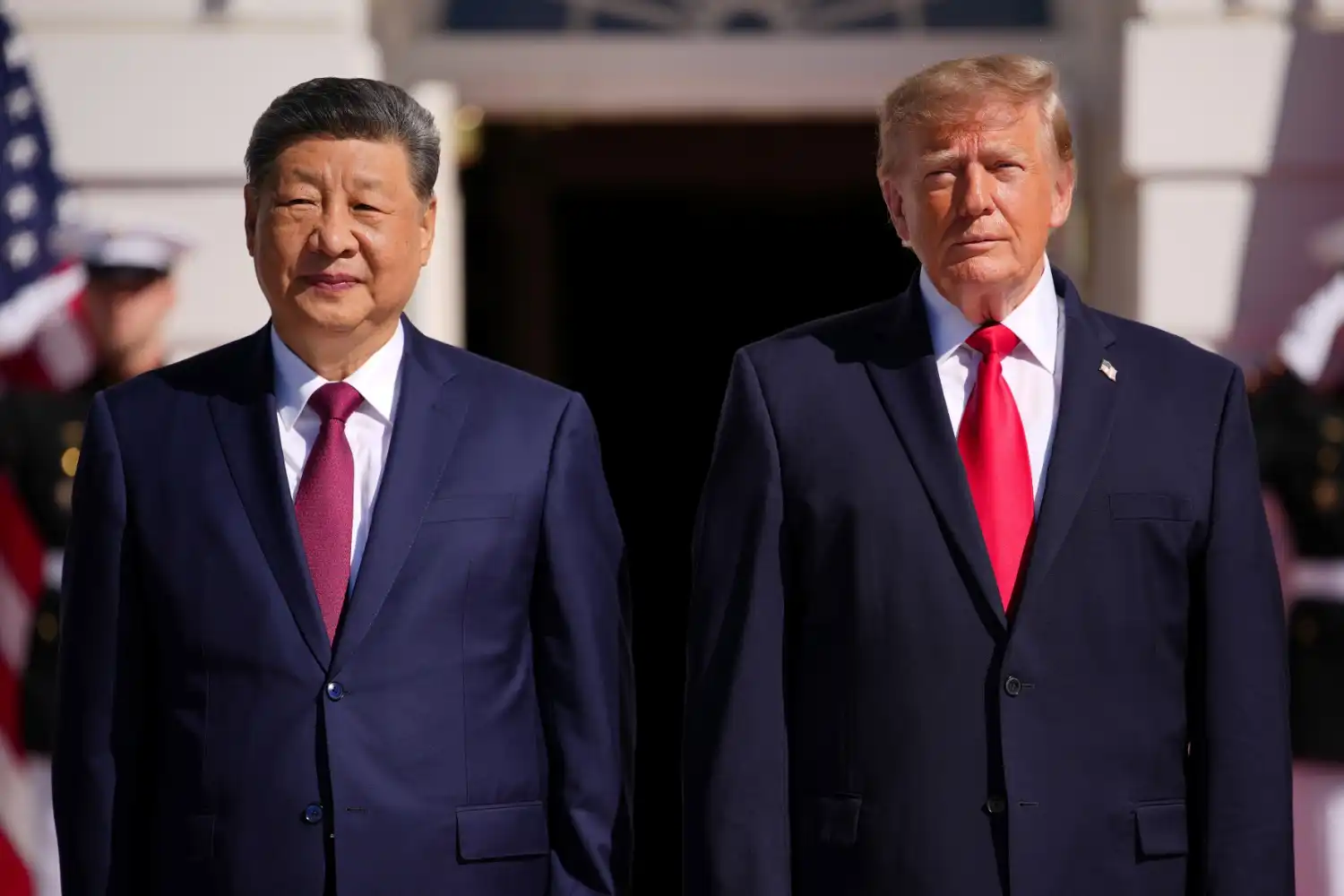
President Donald Trump welcomed Chinese President Xi Jinping to Washington on September 23, 2026, beginning a three-day state visit focused on the future of U.S.-China relations. Xi’s arrival at Joint Base Andrews featured an unusually formal reception, with Trump personally greeting him on the tarmac. The visit comes as Washington and Beijing continue negotiations over trade, technology, Taiwan and other major geopolitical issues.
Xi Receives Rare Airport Welcome
Xi arrived at Joint Base Andrews on Wednesday evening with Chinese First Lady Peng Liyuan. Trump and First Lady Melania Trump walked onto the tarmac to greet the Chinese president and his wife.
The reception included a red carpet, military honors, ceremonial music and a flyover. Trump personally meeting Xi at the airport was unusual under normal U.S. diplomatic protocol, in which visiting heads of state are generally received at the White House rather than on arrival.
The highly visible welcome reflected the importance both governments placed on the visit.
Trade Truce Extended
One of the most immediate developments surrounding Xi’s arrival was an agreement to extend the existing U.S.-China trade truce until January 10.
The temporary arrangement involves reduced tariffs and a pause on some additional trade restrictions while negotiations continue. Treasury Secretary Scott Bessent announced the extension as Xi arrived in Washington.
Trade remains one of the central issues in the relationship. The two countries have imposed tariffs and export restrictions on one another in recent years, affecting manufacturers, agricultural producers, technology companies and international supply chains.
AI Becomes a Major Topic
Artificial intelligence is another important issue for Trump and Xi.
The United States and China are competing for leadership in advanced AI, while both governments are also discussing ways to manage potential risks associated with increasingly capable systems.
During the summit, the two countries agreed to establish an AI safety communication channel designed to help manage AI-related risks and crises. They also agreed to continue discussions between officials on the technology.
The development comes shortly after AI executives appeared before the UN Security Council to discuss international AI safety concerns.
Taiwan Remains a Major Disagreement
Taiwan is expected to remain one of the most sensitive subjects in U.S.-China relations.
Beijing considers Taiwan part of China and opposes moves toward Taiwanese independence. Washington maintains unofficial relations with Taiwan and provides it with military equipment.
Chinese officials have pressed the United States over Taiwan-related arms sales and Washington’s broader security relationship with the island. The issue remains separate from the trade negotiations and has the potential to create significant tension between the two governments.
Iran Also Enters the Conversation
The ongoing war involving Iran adds another layer to the summit.
China remains an important economic partner for Iran, including as a buyer of Iranian oil, while the Trump administration has been applying pressure on Tehran.
Reuters reported that the U.S. and China continued to have differences over China’s relationship with Iran during the summit.
The issue places the U.S.-China relationship within a broader international crisis involving energy supplies, sanctions and regional security.
Rare Earths and Technology
Critical minerals and advanced technology are also central to the economic relationship.
China plays a major role in global rare-earth supply chains, while the United States has imposed restrictions on some advanced technologies and semiconductor-related exports to China.
These issues affect industries including:
- Semiconductors
- Electric vehicles
- Consumer electronics
- Aerospace
- Defense
- Artificial intelligence
- Renewable energy
Managing these supply chains is therefore an important part of the broader U.S.-China economic relationship.
A Visit Filled With Symbolism
The ceremony surrounding Xi’s arrival received considerable attention because of its unusual scale.
The leaders’ highly publicized meeting was designed to demonstrate diplomatic engagement despite continuing disagreements. Xi’s visit was also the first Chinese state visit to Washington in more than a decade.
The two governments had already established several areas for continued negotiation, including trade and AI.
What Happened After the Visit?
The three-day summit concluded on September 25.
The countries extended their existing trade truce and agreed on several areas for continued cooperation. According to the White House, the two sides reached consensus on more favorable tariff treatment for approximately $30 billion of non-sensitive goods in each direction and launched additional working groups on trade and investment.
The countries also agreed to continue AI and military communication discussions, while major differences remained over Taiwan, Iran and other strategic issues.
Global Impact
The relationship between Washington and Beijing affects businesses and governments far beyond the two countries.
Changes in tariffs can influence the prices of imported goods, while restrictions on technology and critical minerals can affect global manufacturing.
A more stable trade relationship could give companies additional time to plan investments and supply chains, while renewed restrictions could create new uncertainty.
The summit therefore attracted attention from financial markets, technology companies, manufacturers and governments around the world.
Conclusion
Trump’s welcome of Xi Jinping to Washington on September 23, 2026, marked the beginning of a major U.S.-China summit. The three-day visit brought the leaders together to discuss trade, tariffs, artificial intelligence, Taiwan, critical minerals and the war involving Iran.
The two countries subsequently extended their trade truce and established additional mechanisms for discussions on trade, investment, AI and military communication. At the same time, significant differences remained on several geopolitical and technological issues.
The summit represents another stage in ongoing efforts by Washington and Beijing to manage their increasingly complex relationship while continuing to compete over technology, trade and global influence.